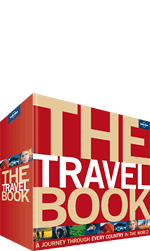
The Big Fat Travel Book

by Meg Robbins
( May 29th, 2011 )


The Travel Book: A Journey Through Every Country in the World, Lonely Planet
This ten pound baby (I stood on the bathroom scale with it and used it to hold a poster flat) gives serious meaning to the concept ‘Coffee Table Book’,  but it’s a big world out there Momma and if you’re going to call a book THE Travel,it had better be impressive. A huge and dynamic undertaking by our Lonely Planet pals, this second edition opulent treasure chest sparkles with photographic gems for every nation in the world (there are 229 including the 11 small dependencies tossed in as appetizer) from Afghanistan to Zimbabwe.  The book’s goal is to present a “subjective” view of the world—which if you think about it, is very Lonely Planet.

Following the trend of LP’s other Big Books the book’s jacket is not impressive (gold background and big fat title with some teeny-weeny little photos stuck in the middle), which is a shame as coffee table books should shine as art from the outside in, but you’ll probably always have it propped open- no worries except for all those coffee cup rings on Moldova.

So who doesn’t love a book you can open to any page and get huge, gorgeous photos overlapping two pages per nation with a sidebar of Useful Information?  Close your eyes and open the Travel Book about half way (page 209 out of 447) and you get Kiribati (hands up everyone who already knew about these 33 small South Pacific islands).  A dominating photo of azure sea, thatched hut, fishermen and blue, blue skies are juxtaposed under a trio of riveting smaller photos: Young Girl in native dance shell headdress, Heart-Shaped Shell Midden/Harbor in aforementioned azure sea, and identically smug grins by Toddler and Woman tending a catch line-up of Very Big Fish stood on their heads awaiting purchase. Rich colors, endless sea, compelling humans.

Or flip forward a hundred pages plus to the P’s (the book is sensibly alphabetized) and you get Poland (p. 321). Big photo gives us Czocha Castle in Lesna under a fresh powdering of snow, an autumnal walk over russet leaves under the huge trunks of Wolski Forest, and two detailed Warsaw photos (soldiers/church). But that’s not all! For every country’s gorgeous pictures we also get that very Lonely Planet sidebar. One paragraph in bold gives us a nutshell nation intro (Poland’s starts with geographical location but very quickly gets to vodka) and a set list of headings.  Still in Poland we get a sort of Alice Does Wonderland list: Best Time To Visit (May-September), Top Things To See, Top Things To Do (Death Camp memorials, European bison, Hiking to the Black Madonna and Tatra Mountains).  Getting Under the Skin. Read This Book, Listen To This Music, Watch These Films, Eat This Food (pieriogi or borscht), and Drink This Beverage (back to vodka) round out the advice snippets. You get the feeling that the book’s contributors thoroughly enjoyed this kind of list-making.

In A Word gives us a useful greeting (Dzien dobry—good day), Trademarks (Pope John Paul II, pierogi, vodka, Joseph Conrad), Random Fact (Marie Curie) and a mini map. That’s a lot of good stuff in a short list and it’s hedged in by a sideways sidebar giving us the kind of information we might need for our 7th grade geography report (Capital, Population, Area and Official Language).

So who buys books like this? Hopefully someone who wants to give you one, if your coffee table is up to it.  If it doesn’t, you might go for the book in its mini edition, 4 pages per country, still fat but less than half the weight. And what about our own United States of America? We get the same two pages New Guinea gets (Grand Canyon, Las Vegas, New Orleans and Central Park) and FYI LP recommends in Getting Under the Skin that we watch Dr. Strangelove, listen to Willy Nelson, eat regional cuisine (what a cop-out), drink microbrews and California reds and learn to greet the locals in their own tongue by saying, “Yo!” “Howdy!” “Hi!”


Wandering Booklust/Meg Robbins

1 comment
 

Backpacking Your Way to a New You

by Meg Robbins
( May 3rd, 2011 )

The Good Girl’s Guide to Getting Lost

So…imagine that we’re 20 and deeply enmeshed in being “good girls”. We practice our viola daily for hours, we get good grades and we don’t get pulled over for speeding.  Girls like us know what our next steps are after college. And the next.  And the next.  And there’s no time to lose in the battle to get those pieces all in place. So. Big question. Are we happy? Author Rachel Friedman finds herself not unhappy but no longer on a clear path to next when she falls off the viola wagon. So she goes to Ireland on a vague summer’s work visa, ends up in Galway and rethinks the direction of the rest of her life. While this is hardly a cause for pause for bad girls, it is supreme challenge for those gone good. Friedman astonishes herself, awakes her hidden wanderlust and goes down the path of no return (although she does collect a college degree on the way).  Ireland, Australia, South America and a collision romance with a mysterious Kiwi, she veers off that good girl fast track and joins the world of aha.

This is a very satisfying tale. What does it offer us as readers other than a comforting sense of complicity? Edifying insight into hostel existence and bungee jumping, some useful information about why drinking beer in the Andes is a bad idea, and a contemplative ‘really it’s okay’ leap into alternative realities.  Friedman, unable to shake a lifetime practice of thinking before jumping, records her conversations with herself as she pulls farther and farther away from her cultural norm.  Diving against her better judgment into a fast river in Kakadu National Park near Darwin which may or may not harbor crocodiles, she makes it to ‘the other side.’ “I like backpacker me,” she journals. “She is easygoing. She talks less, listens more. She doesn’t wear a watch. “
If you find yourself slipping into wayward, It helps to have a wayward best friend and Friedman’s Galway find is Australian Carly who recognizes a fellow  bushwacker when she sees one.  “ I’m only working to make some euros to spend traveling around. The Australian dollar is worthless over here.” And that, in a nutshell is that. Thank god for transient work in pubs, the universal hostel traveler’s paycheck.  Carly is a Free Spirit (following in her mother’s wandering footsteps) and Freidman learns more about how ‘free’ and ‘spirit’ connect as she travels with (and without) Carly.

Ultimately this entertaining book is a good candidate for the “Travel as Self Help’ genre as the author’s childhood involves the dual traumas as a child of divorce and growing up in snow belt Syracuse with parental expectations of academic excellence.  Finding oneself by exploring the world is not a new therapy nor is writing about it but it’s supremely relevant for all of us who have been, will be or are contemplating change.  While Friedman calls this finding  “getting lost” she engagingly chronicles that journey for us aptly enough for us to eagerly look forward to her sequel –Kiwi Romance.

Wandering Booklust/MegRobbins

Permalink

2 comments
 

Running Around the World:Second Wind

by Meg Robbins
( April 1st, 2011 )

I don’t know about you but when I plan international  travel, one thought that definitely does not cross my mind is, “...and while I’m there I think I’ll run a marathon.”

I do have an acquaintance who travels internationally to run marathons for fame and fortune but his agent makes sure the package he is offered includes first class airfare, five star hotels and the wife and kids.  But then of course he still has to run  the better part of 27 miles.

Washington-based Cami Ostman author of Second Wind subtitles her book, One Woman’s Midlife Quest to Run Seven Marathons on Seven Continents, which instantly made me head-snap a picture of super-jock.  She’s not.  Ostman might more accurately have added a little visual appeal to we of more modest enthusiasms — One Woman’s Midlife Quest to Run Seven Marathons on Seven Continents Very Slowly, Often Last and Usually Staying in Hostels.

Ostman never considered herself a runner until her friend and future spouse Bill nagged her to give it a try as midlife therapy to ease the segue from a bad marriage and not coincidentally, exodus from eleven years of life in an intensely male -dominant religious community. He enthusiastically exhorts her on what is really a prelude to a first date, that running, “...really helped me clear my mind and get in touch with my feelings during a difficult time…I ran until it hurt more on the outside than on the inside. You should try it. It works.” Here’s where I started to really like Ostman. She thinks about this for a minute, decides she is actually looking for less pain not more pain, and answers, “ How about getting together sometime for a movie instead?”

Ostman doesn’t stand a chance as a non-runner if she hangs around with Bill and predictably gets caught up in the zen of setting a challenge that will represent her freedom from the past and her strength for the future.  For some reason, despite her Not-A-Winner racing pace, she chooses to run a marathon. Soon after that, she insanely agrees (Bill again) to run one on each of the seven continents. Apparently this is a surprisingly common goal for traveling marathoners many of whom sign up with specialist  Marathon Tours (who figure as protagonists in Ostman’s story) and others like Ostman and Bill who  just launch out on their own.

The rules are no duh simple—complete a marathon on each continent. Ostman decides that can be at a jog, a run, a walk or a crawl in an organized race in the US, Canada, South Africa, Australia, Panama City, Rio, Chile, Japan, Prague, or back and forth between huts over ice in Antartica and doesn’t require a finisher’s medal but it’s especially sweet when one appears . She graphically details her personal challenges while running (blood, sweat, tears and Tampax) although her aim is only to finish, and her competition just herself as she starts at the back of the pack and stays at the back of the pack. When you think about it, her marathon at a slow five plus hours may be far more taxing than those who confidently zoom home in under three.  She often finds herself running with her loudly vocal Inner Bitch and Inner Wisdom who duel it out as the kilometers roll on.  Once or twice God handily shows up to holler “Turn left!”.

So how is this a travel book? Curiously it is in an almost genre-free category.  Second Wind takes us  (very, very slowly) through the back roads and main streets of towns and cities around the world. We don’t  “see” the guidebook sites but we certainly “feel” the iconic culture sometimes through the palsy lens of ‘sister cities’, we get an insider’s view at marathoning across the globe. We walk away actually wondering if we too could just gently jog our way through not quite 27 miles of eye-catching scenery in choose-your-own –adventure sites in every continent on planet earth.

Wandering Bookluster—Meg Robbins 4/2011

2 comments
 
Contact Us · About · WanderTales · Advertise · Bhutan Tours · WanderBlogs· WanderTips · WanderGear · Newsletter · WanderGallery · Buy Solo Book · Buy India Book · Book Reviews · Book Signings · Workshops · Speaking · Media · News · Images · Copyright & Privacy · Site Map